|
 |
|
The Landing Craft, Air Cushion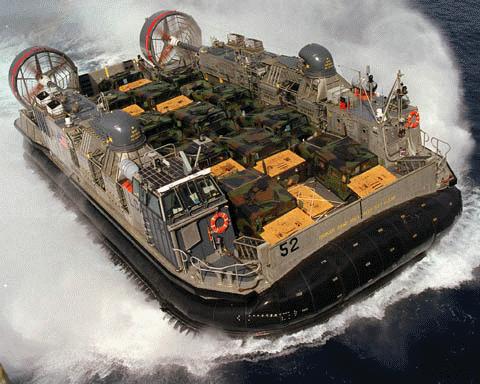
(LCAC -- pronounced Ell-Cack) Transport weapons systems, equipment,
cargo and personnel of the assault elements of the Marine Air/Ground
Task Force both from ship to shore and across the beach. The landing
craft air cushion (LCAC) is a high-speed, over-the-beach fully amphibious
landing craft capable of carrying a 60-75 ton payload.
Capable of operating from existing and planned well deck ships, it
is used to transport weapons systems, equipment, cargo and personnel
from ship to shore and across the beach. The advantages of air-cushion
landing craft are numerous. They can carry heavy payloads, such as an
M-1 tank, at high speeds. Their payload and speed mean more forces reach
the shore in a shorter time, with shorter intervals between trips. The
LCAC is capable of carrying a 60 ton payload (up to 75 tons in an overload
condition) at speeds over 40 knots. Fuel capacity is 5000 gallons. The
LCAC uses an average of 1000 gallons per hour. Maneuvering considerations
include requiring 500 yards or more to stop and 2000 yards or more turning
radius.
The LCAC, like all "hovercraft," rides on a cushion of air. The air
is supplied to the cushion by four centrifugal fans driven by the craft's
gas turbine engines. The air is enclosed by a flexible skirt system
manufactured of rubberized canvas. Unlike the Surface Effect Ship (SES),
no portion of the LCAC hull structure penetrates the water surface;
the entire hull rides approximately four feet above the surface. LCAC
operates in waters regardless of depth, underwater obstacles, shallows
or adverse tides. It can proceed inland on its air cushion, clearing
obstacles up to four feet, regardless of terrain or topography), including
mud flats, sand dunes, ditches, marshlands, riverbanks, wet snow, or
slippery and icy shorelines. Equipment, such as trucks and track vehicles,
can disembark via ramps located both forward and aft, there by shortening
critical off load time. LCAC is a dramatic innovation in modern amphibious
warfare technology. It provides the capability to launch amphibious
assaults from points over the horizon, thereby decreasing risk to ships
and personnel and generating greater uncertainty in the enemy's mind
as to the location and timing of an assault, thereby maximizing its
prospects of success. It is also important to point out the LCAC propulsion
system makes it less susceptible to mines than other assault craft or
vehicles.
Previously, landing craft had a top speed of approximately eight knots
and could cross only 17% of the world's beach area. Assaults were made
From one to two miles off-shore. Due to its tremendous over-the-beach
capability, LCAC is accessible to more than 80% of the world's coastlines.
It can make an undisclosed, over the horizon (OTH) assault from up to
50 miles offshore. Its high speed complements a joint assault with helicopters,
so personnel and equipment can be unloaded beyond the beach in secure
landing areas. For 20 years, helicopters have provided the partial capability
to launch OTH amphibious assaults. Now, with LCAC, landing craft complement
helos in speed, tactical surprise and without exposing ships to enemy
fire. With LCACs in the fleet, an amphibious assault force could be
nearly 500 miles away at H-hour minus 24 and still make pre-dawn attack
launched from beyond an enemy's horizon.
The LCAC's air-cushion capability also allows it to proceed inland
beyond an enemy's horizon to discharge cargo on dry, trafficable beaches,
thus reducing build-ups of troops, equipment and other material in the
surf zone. LCAC was developed to satisfy the need for an air cushion
landing craft capable of carrying troops, artillery, tanks, combat vehicles,
and other major items of combat and combat support equipment across
the beach.
|
|
 |
|


